

Trump Rejects Khamenei’s Son as Iran’s Next Leader
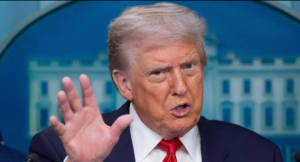
United States President Donald Trump has declared that the son of Iran’s late supreme leader cannot succeed his father, insisting that America should have a say in who becomes the country’s next leader.
Trump made the remarks in an interview with Axios, days after the death of Iran’s longtime supreme leader Ali Khamenei, who was reportedly killed during a joint United States-Israel strike on his residence in Tehran amid the ongoing conflict in the region.
Speaking on the succession battle now unfolding in Iran, the American leader said he would oppose the emergence of Khamenei’s son, Mojtaba Khamenei, who has been widely mentioned as a possible successor.
Trump described the cleric as “unacceptable” and dismissed him as a “lightweight,” saying the United States wanted to see a leader who would bring stability and peace to Iran rather than continue the policies of the previous regime.
“I have to be involved in the appointment,” Trump said, suggesting that Washington should influence the process that will determine the next supreme leader of the Islamic Republic.
According to him, allowing a hard-line figure similar to the late Khamenei to assume power could trigger another round of confrontation between Iran and the United States within a few years.
Trump warned that the worst outcome of the current war would be replacing the slain leader with someone who maintains the same ideological and political approach.
“I guess the worst case would be we do this and then somebody takes over who’s as bad as the previous person. We don’t want that to happen. We want somebody who will bring it back for the people,” he said.
The US president also suggested that many individuals previously considered by Washington as potential alternatives in Iran’s leadership had already been killed in the ongoing conflict.
The controversy surrounding Iran’s leadership succession comes at a time of heightened tension in the Middle East following military operations launched by the United States and Israel against Iranian targets.
Reports indicate that the conflict has already resulted in heavy casualties on multiple sides and intensified geopolitical uncertainty in the region.
Who is Mojtaba Khamenei?
At the centre of the succession debate is Mojtaba Khamenei, the second-eldest son of the late Iranian leader and a relatively secretive cleric who has long been considered one of the most influential figures behind the scenes in Iran’s political establishment.
Born in 1969 in Mashhad, Mojtaba studied at the religious seminary in Qom and served in Iran’s armed forces during the Iran-Iraq war in the late 1980s.
Although he has rarely held formal government positions, analysts say he has wielded considerable influence within the office of the supreme leader and maintains close ties with the powerful Islamic Revolutionary Guard Corps.
Over the years, speculation about his possible succession intensified, especially after he was reportedly given the title of ayatollah in 2022, a development that many observers interpreted as a step toward positioning him for leadership.
His potential rise has, however, been controversial both inside and outside Iran.
Critics argue that allowing a son to replace his father would resemble hereditary rule, something the Islamic Republic has historically rejected since the 1979 revolution that ended monarchical governance in the country.
Despite these concerns, Mojtaba has been widely regarded as one of the strongest contenders for the role of supreme leader because of his close relationship with key political and military institutions within the Iranian system.
Succession process underway
Under Iran’s constitution, the country’s supreme leader is chosen by the Assembly of Experts, a powerful body of senior clerics responsible for selecting and supervising the country’s highest authority.
The position carries enormous influence, giving its holder ultimate control over Iran’s armed forces, judiciary and major policy decisions.
With the death of Ali Khamenei after more than three decades in power, attention has now shifted to how the Assembly will navigate the sensitive process of choosing his successor at a time of war and political uncertainty.
Trump’s comments have added another layer of controversy to the already tense situation, as Iran has historically rejected any suggestion of foreign involvement in its internal political affairs.
Iranian authorities have not formally responded to the US president’s remarks, and the country has yet to officially announce a permanent successor to the late leader.
📢 Follow National Periscope on WhatsApp
Get breaking news and updates directly on WhatsApp.
Join WhatsApp ChannelPost Disclaimer
All rights reserved. This material and other digital content on this website are not and do not represent the stance of National Periscope but the statements of newsmakers mentioned therein.
For your detailed news reportage... contact the Editor at Joel2oladele@gmail.com



Midday darkness falls across North America as total solar eclipse Read more
Japan earthquake survivors face freezing temperatures, heavy rain and threat Read more
Unable to survive in Egypt, refugees return to war-torn Sudan Read more
Khamenei’s Wife Dies After Weekend Airstrikes Mansoureh Khojasteh Bagherzadeh, wife Read more