

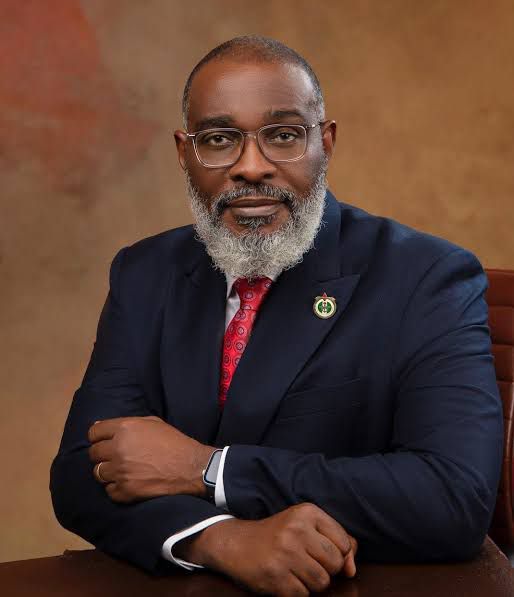
At a time when Nigeria’s security challenges demand coordination more than competition, strategy more than noise, and intelligence more than reaction, Major General Adeyinka Famadewa emerges as one of the most consequential security appointments in recent years.
For years, Nigeria’s battle against insurgency, banditry, kidnapping, organized crime, and transnational threats has exposed one recurring weakness within the nation’s security architecture, fragmented intelligence coordination.
While various agencies often possessed critical pieces of information, the absence of synchronized operational intelligence frequently weakened the speed, precision, and effectiveness of national response.
It is within this context that General Famadewa’s emergence carries profound significance.
Unlike many officers whose reputations were built primarily on battlefield visibility, Famadewa belongs to a distinct class of military professionals whose strength lies in strategic intelligence coordination, institutional discipline, and inter-agency collaboration.
Throughout his military and national security career, he developed a reputation as a quiet but highly effective intelligence strategist deeply involved in strengthening Nigeria’s security coordination systems during some of the country’s most difficult years.
His experience reflects an important reality often overlooked in national security conversations: homeland security is not merely about deploying force. It is about anticipation, prevention, coordination, resilience, and national preparedness.
It involves integrating intelligence, border security, cyber awareness, infrastructure protection, emergency management, and internal stabilization into one coherent national strategy.
Nigeria’s present security environment requires precisely this kind of strategic coordination.
The country is confronted by evolving threats that transcend conventional warfare: cybercrime, economic sabotage, terrorism financing, organized criminal networks, arms trafficking, separatist tensions, and growing instability across West Africa and the Sahel.
These are not challenges that can be solved through isolated kinetic operations alone. They require intelligence-led governance, synchronized national security management, and sustained inter-agency cooperation.
This is where General Famadewa’s experience becomes particularly invaluable.
His understanding of intelligence architecture and institutional coordination positions him uniquely to strengthen collaboration among the Armed Forces, intelligence agencies, the police, immigration services, civil defense structures, and other strategic national institutions.
More importantly, his appointment signals a potential shift from reactive security management to proactive homeland security planning.
For many observers, this appointment is not simply about filling an office. It represents a growing recognition that modern security success depends heavily on strategic intelligence integration.
Nigeria’s victory against insecurity will not come solely from weapons acquisition or troop deployments. It will come from building an intelligent national security system capable of predicting threats, sharing actionable intelligence in real time, coordinating rapid responses, and sustaining institutional cooperation without rivalry or bureaucratic fragmentation.
General Adeyinka Famadewa appears well suited for that mission.
At a critical moment in Nigeria’s security evolution, his appointment may well become a major catalyst in reshaping the nation’s internal security framework and strengthening the long-term fight against insecurity.
If effectively empowered and institutionally supported, history may remember this moment not merely as another government appointment, but as the beginning of a more coordinated, intelligence-driven, and strategically integrated era in Nigeria’s national security management.
Olufemi Ibitoye writes from Abuja.
📢 Follow National Periscope on WhatsApp
Get breaking news and updates directly on WhatsApp.
Join WhatsApp ChannelPost Disclaimer
All rights reserved. This material and other digital content on this website are not and do not represent the stance of National Periscope but the statements of newsmakers mentioned therein.
For your detailed news reportage... contact the Editor at Joel2oladele@gmail.com





[caption id="attachment_22506" align="alignnone" width="600"] Institutional Archivist and Public Commentator, David Read more
Today, June 12, Nigeria rolls out the drums to celebrate Read more
Regular consumption of beans won’t make children of short parents Read more
Dismantling the False Narrative of a "Coup" in Rivers State Read more