

Iran Rules Out Ceasefire as Trump Escalates Threats Over Strait of Hormuz
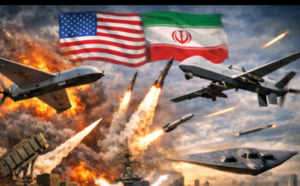
Iran on Tuesday insisted it was not seeking a ceasefire despite intensifying military pressure and mounting threats from the United States over the strategic Strait of Hormuz, as fresh explosions rocked the capital, Tehran.
The conflict has continued to deepen across the Middle East since the February 28 joint strikes by the United States and Israel that reportedly killed Iran’s supreme leader, Ali Khamenei, sparking the current war with Iran.
Iranian leaders have vowed to resist pressure from Washington, even as the United States intensifies its air campaign.
Speaker of the Iranian parliament, Mohammad Bagher Ghalibaf, declared that Tehran would not back down from the confrontation.
“Certainly we aren’t seeking a ceasefire,” Ghalibaf wrote in an English-language post on X.
“We believe the aggressor must be punished and taught a lesson that will deter them from attacking Iran again,” he added.
Earlier, US Defense Secretary Pete Hegseth said American forces were preparing what he described as their most powerful wave of attacks so far.
“Today will yet again be our most intense day of strikes inside Iran; the most fighters, the most bombers,” he told reporters.
The crisis has also rattled global energy markets after Iranian attacks on shipping forced the closure of the vital Strait of Hormuz, a narrow waterway through which roughly a quarter of the world’s seaborne oil and about one-fifth of global liquefied natural gas supplies normally pass.
US President Donald Trump warned Tehran against planting naval mines in the waterway.
“If for any reason mines were placed, and they are not removed forthwith, the military consequences to Iran will be at a level never seen before,” Trump wrote on his Truth Social platform.
The warning followed a report by CNN citing intelligence sources that Iran had begun placing explosives in the strategic channel.
In Tehran, two rounds of explosions were heard Tuesday evening, according to journalists from Agence France-Presse (AFP), although the specific targets were not immediately known.
A resident in her forties told AFP she felt some reassurance that the strikes appeared not to target residential buildings but admitted the situation remained frightening.
“It’s the noise of the bombings that is extremely disturbing,” she said.
Iran’s Islamic Revolutionary Guard Corps responded by launching a fresh wave of missiles toward Israeli cities and US military positions in the region.
Explosions were later heard in Manama, AFP journalists reported.
Oil Markets Jittery
The conflict has caused sharp swings in global oil prices, which briefly eased on Tuesday after US Energy Secretary Chris Wright said the US Navy had escorted an oil tanker through the Strait of Hormuz.
However, the statement was quickly withdrawn and the White House later clarified that no such naval escort had taken place.
Earlier Iranian attacks, as well as strikes on oil facilities in the Gulf, had sent energy prices surging.
In the United Arab Emirates, the country’s largest refinery in Ruwais was temporarily shut on Tuesday as a precaution after a drone strike caused a fire at the industrial complex, a source familiar with the incident told AFP.
A driver working at the facility said he saw “bursts of fire rising from the complex, with loud sounds like explosions”.
Meanwhile, Qatar reported continuing Iranian attacks on civilian infrastructure, while AFP journalists also heard explosions in Doha.
Energy analysts have warned that prolonged disruption to shipping through the Strait of Hormuz could trigger serious consequences for the global economy.
President and CEO of Saudi Aramco, Amin H. Nasser, said restoring maritime traffic through the waterway was critical.
“There would be catastrophic consequences for the world’s oil markets the longer the disruption goes on,” he said.
Economic Concerns Rising
The crisis is also raising fears about the cost of living in many countries.
The United Nations Conference on Trade and Development warned that continued disruption in the Gulf could drive up the prices of essential commodities such as fuel and food, particularly for vulnerable populations.
In Cairo, where the government recently increased fuel prices by up to 30 percent, many residents expressed concern.
“We were barely getting by as it is. I don’t know how people will manage,” a mother of six identified as Om Mohamed told AFP at a local market.
Market analysts say uncertainty remains high as the conflict shows no sign of ending soon.
“Rare are days in the markets when you get this much volatility,” said Ipek Ozkardeskaya, an analyst at Swissquote Bank.
“The conflict in the Middle East continues at full speed, political developments are not pointing to a near-term resolution, and there is little clarity about US plans,” she added.
Source: AFP
📢 Follow National Periscope on WhatsApp
Get breaking news and updates directly on WhatsApp.
Join WhatsApp ChannelPost Disclaimer
All rights reserved. This material and other digital content on this website are not and do not represent the stance of National Periscope but the statements of newsmakers mentioned therein.
For your detailed news reportage... contact the Editor at Joel2oladele@gmail.com





US Warplanes Crash in Kuwait as Regional Crisis Intensifies Kuwait’s Read more
US returns $52.88m Diezani Alison-Madueke’s loot to Nigeria The Federal Read more
Trump defies judge, gives courtroom speech on tense final day Read more
US tells Israel it will not take part in retaliatory Read more